Home Wellbeing
How Nature Can Help You Find Your Interior Style
Sometimes the best inspiration for your home can be found outside it
Published · September 2026
Close your eyes for a moment and imagine a place where you feel completely relaxed.
What do you see?
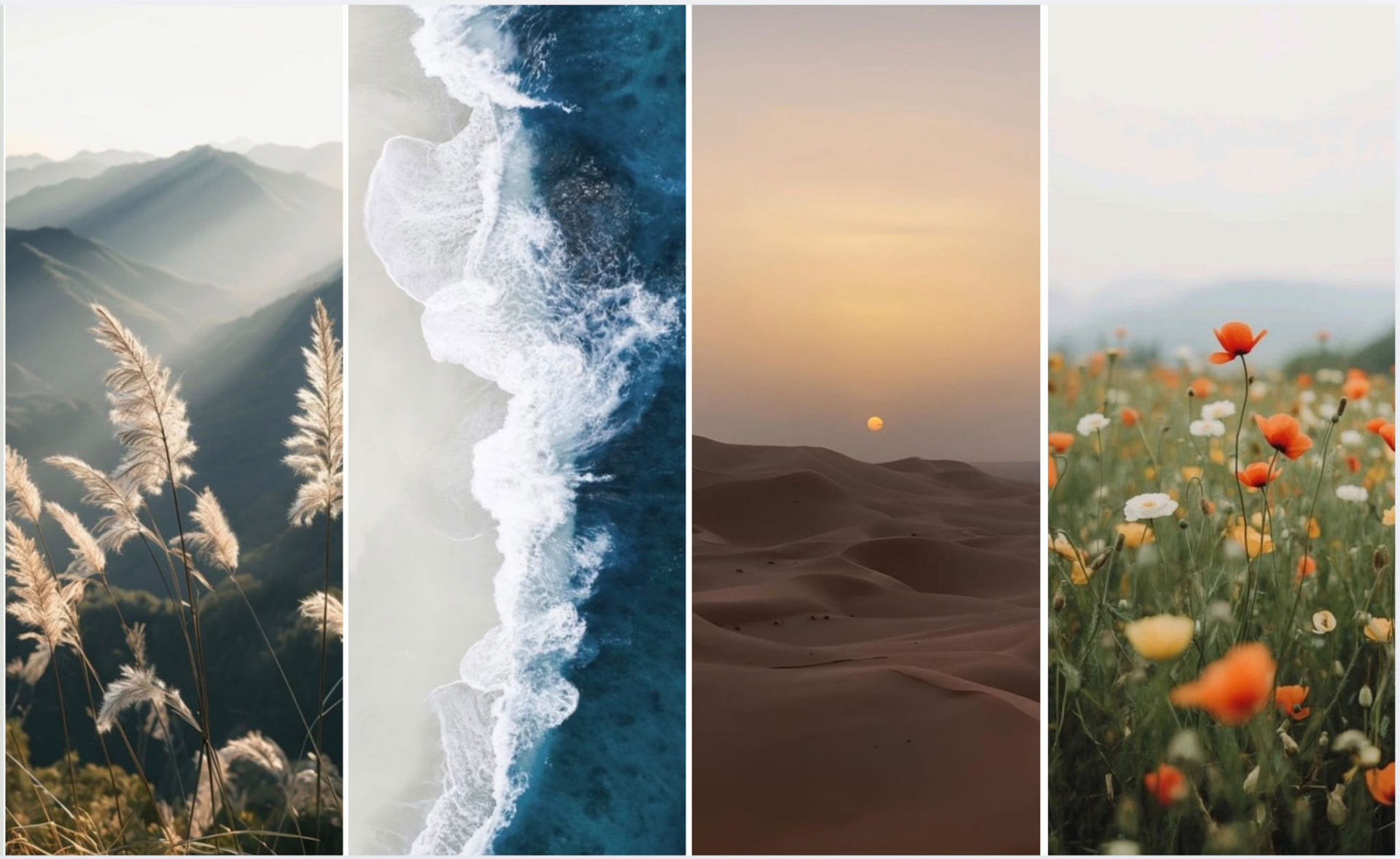
Perhaps you are high in the mountains, looking across an open landscape. Maybe you are standing by the sea, walking through a forest, surrounded by the warm colours of a dry landscape, or in a meadow full of wildflowers.
Before thinking about interiors, stay there for a moment. What are the colours around you? Is the light bright or soft? Does the place feel open and expansive, or sheltered and intimate? What textures do you notice? Is there water, stone, timber, sand or grass?
And most importantly: how does that place make you feel?
This can be a surprisingly useful place to begin when trying to understand your own interior style.
Nature as inspiration, not decoration
When we look for inspiration for our homes, we often begin with other interiors. We save images, create Pinterest boards and try to decide whether our style is contemporary, Scandinavian, minimalist, classic or eclectic.
There is nothing wrong with any of these styles. If you know exactly what you like, a style can be a useful language. But if you are not sure, I find it interesting to begin somewhere else: with places where you already know you feel good.
Nature offers extraordinary combinations of colour, texture, light, proportion and contrast. Translating nature into an interior, however, does not mean copying it literally. Loving the sea does not necessarily mean a blue-and-white home. Perhaps what you are responding to is openness, movement, reflected light, freshness or simplicity. A forest may become timber, tactile surfaces, deeper tones and filtered light. A dry landscape may suggest mineral colours, linen, clay and sun-washed textures.
Nature can inspire an interior without becoming its theme.
More than a visual connection
Our response to nature is not only aesthetic.
The way we experience a place is shaped by many things at once: light, colour, material, sound, temperature, spatial proportions, memory, culture and personal associations. There is no single natural environment that works best for everyone.
For me, that is exactly what makes nature interesting as a design tool. It is not simply about extracting a colour palette. It is about asking what we respond to in a landscape — and why.
For me, it is the mountains
For me personally, the answer is easy. I love the mountains and the forest. I love the smell of the trees, timber, greens, the changing colours of the landscape and the blue of the sky.
But when I think about it more carefully, colour is only part of the attraction. What I love most is the feeling of reaching an open place high in the mountains and suddenly having space around me. I can breathe. Nothing feels visually heavy or as though it is closing in on me.
I realise that I look for something very similar in my own home. I naturally use a lot of wood and other natural materials. I am drawn to greens, touches of yellow and blue, plants and materials with visible texture and natural variation. But equally important is the feeling of space. I do not like my surroundings to feel unnecessarily crowded. I want objects to have room around them and the interior to feel light and breathable.
I am not trying to bring the mountains into my home. I am trying to bring home something of the way the mountains make me feel.
Two people can love exactly the same landscape for completely different reasons — and therefore translate it into two very different homes.
From landscape to interior
The four bedroom examples below illustrate this idea. Each begins with a natural environment and my interpretation of it. I have not tried to reproduce the landscape literally. Instead, I looked at its colour relationships, textures, light and atmosphere and considered how those qualities might become part of an interior.
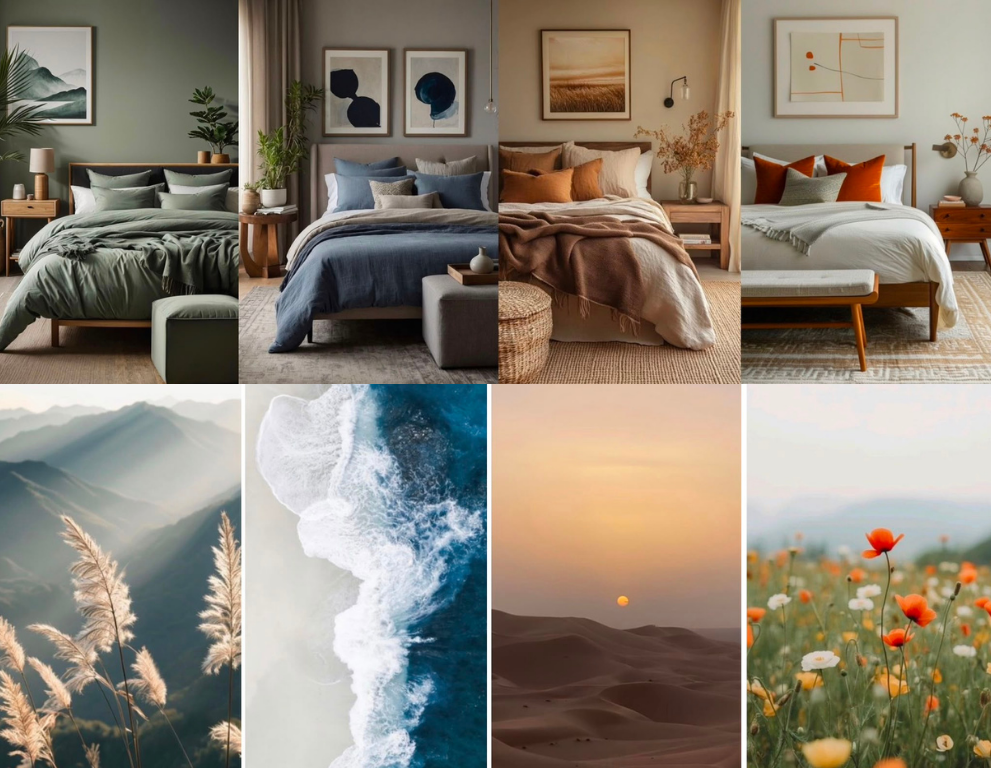
- Mountains — muted greens · soft greys · timber · natural texture · openness
- Sea — deep blue · soft neutrals · freshness · movement · simplicity
- Desert — sand · clay · ochre · tactile textiles · warmth
- Meadow — soft greens · warm white · touches of orange · lightness · spontaneity
These are not four interior styles or formulas to follow. They are simply four possible interpretations. Someone else could look at exactly the same landscape and notice something entirely different. And that is the point.
From inspiration to design
This way of thinking is also very close to how I was taught to develop a design concept during my interior design studies.
At the beginning of a project, we were encouraged not to start with furniture or images of finished interiors. Instead, the first moodboard could be much more abstract: colour, form, texture, material, light, rhythm and atmosphere. Inspiration could come from almost anywhere — nature, art, architecture, the texture of stone, the movement of water or the way sunlight falls through trees.
The purpose was not to copy the source. It was to understand what attracted us to it and allow those qualities to inform the design. A line might influence a shape. Layers in a landscape might suggest a combination of materials. Transparency might become glass. A particular rhythm or colour relationship might reappear in furniture, lighting or joinery.
Inspiration does not tell us what to put in a room. It gives us a language from which the room can develop.
The example below shows this process in practice: abstract natural references became a starting point, and their curves, layers, colours and transparency were gradually translated into an interior proposal. The finished room does not need to look like the original source of inspiration at all.
What is your landscape?
If you are trying to understand your own style, try a small experiment. For a moment, stop looking at interiors. Think instead of two or three places in nature where you genuinely feel good.
Then ask yourself what it is about them that attracts you. Is it colour, or the relationship between colours? Bright sunlight or filtered light? Open views or the feeling of being enclosed and protected? Rough stone or smooth surfaces? Abundance or simplicity?
And return to the most important question: how do I feel there? Calm? Energised? Free? Protected? Grounded? Inspired?
Creating a personal interior is not only about identifying what we find beautiful. It is also about understanding how we want our home to make us feel. Once we understand that, we can begin translating it into something tangible: colour, materials, textures, lighting, furniture and the way we organise space.
This is something I also enjoy exploring with clients during my Find Your Style consultations — not deciding what someone's style should be, but helping them recognise what they are naturally drawn to and finding a way to translate it into a home that feels genuinely their own.
Sometimes finding your interior style begins by remembering a place where you already know you feel good.