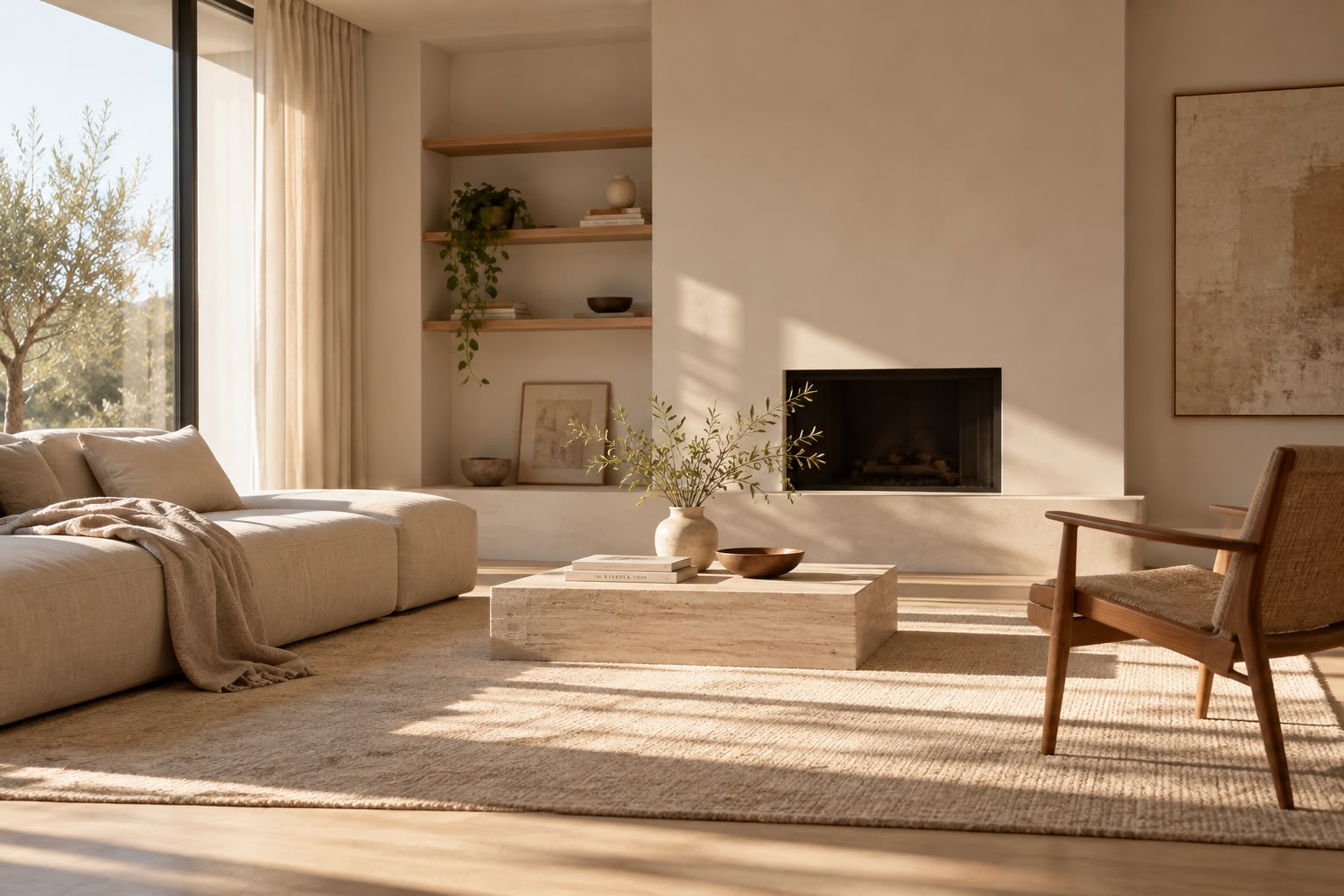
Journal · Design & Personal Style
Beyond Interior Styles: How to Find What Actually Feels Like You
Why your home doesn't need to fit neatly into one design category — and why I don't believe my style should become yours.
Published · October 2026
There is a question that comes up surprisingly often during my first conversations with new clients.
They have usually seen my website and looked through my portfolio. They like what they see — otherwise, presumably, we wouldn't be talking — but then comes a slight hesitation.
“Do you have any other projects I could see? I like your work, but I'm not sure this is really me.”
I completely understand the question. When we choose an interior designer, it seems natural to look through their previous work and try to imagine ourselves living in one of those rooms.
But my answer is usually slightly different.
Yes, I have my own style. You can see some of it in my own home near Bordeaux and, inevitably, in the things I am personally drawn to. Like everyone else, I have colours, materials, objects and periods of design that I love.
But I don't want to give you my style. I want us to find yours.
Your home is not my portfolio
There are designers and architects whose work has a very recognisable visual signature. There is absolutely a place for that kind of work. It simply isn't the way I want to approach somebody's home.
I don't want to take an aesthetic formula that worked beautifully in one house and reproduce it in another. Because the people living there are different. Imagine discovering that your neighbour has hired the same designer as you — and walking into essentially the same living room. It may be beautiful. But is it really yours?
For me, residential design begins with the people who are going to live there. In a family home, that rarely means just one person. One may love calm, minimal spaces; another may have art, books and objects gathered over many years. Children belong in that conversation too. Not everyone needs an equal opinion about every decision, but everyone who lives in a home leaves something of themselves in it.
Sometimes I ask a lot of questions
This is why the beginning of a project is so important to me — and why I may occasionally ask questions that seem surprisingly personal for someone who has come to talk about an interior.
Of course I need to know which colours you like. But I am much more interested in why. I want to know how you spend your mornings, whether you eat together, where everyone disappears to at the end of the day, what you already own and cannot imagine getting rid of, where you have lived before, what you brought back from your travels, and what you want to see when you first walk through the door.
Before we decide what your home should look like, I need to understand something about how you want it to feel — and how you actually live.
A home is a puzzle
I often think of a home as a puzzle that we assemble throughout our lives. Some pieces are chosen deliberately. Others simply find their way to us: a painting from a trip, books that have followed us through three countries, something a child made, or a piece of furniture that belonged to a grandmother.
These things don't necessarily arrive belonging to the same “style”. That is where homes become interesting.
Sometimes my role is simply to find the thread that connects things that, at first sight, don't seem to belong together. An old chest of drawers may feel heavy or dated on its own. Against the right wall, with a contemporary lamp, a piece of art and a material echoed elsewhere in the room, it can suddenly become the object that gives the space its character.
Sometimes the piece that doesn't seem to belong is the piece that makes the room yours.
So what do we actually mean by “style”?
Scandinavian. Minimalist. Contemporary. Traditional. Mediterranean. Mid-century. Japandi. These names are useful: they give us a vocabulary. But they become less useful when we start treating them as rules.
Many of the movements we now reduce to a visual “look” originally represented something much bigger. They were responses to how people were living, making things and thinking about the world.
Arts & Crafts
Britain · late 19th century — William Morris · Philip Webb
Today we might associate Arts & Crafts with William Morris patterns and beautiful handmade objects, but its origins were not simply decorative. The movement developed amid criticism of industrialisation, poor-quality mass manufacture and the separation between designer and maker. What I find especially relevant today is that Arts & Crafts was built around ideas: how things are made, who makes them, and what value we place on the objects around us.


Bauhaus
Germany · 1919 — Walter Gropius · Dessau
Walter Gropius founded the Bauhaus in Weimar in 1919, bringing fine and applied arts into a new kind of school. Students explored colour, form and materials while working practically in workshops. Later the school increasingly investigated design, technology and industrial production. Behind the clean geometry we now recognise was a much larger question: how should we design for a changing world?


Scandinavian Modern
Nordic countries · mid-20th century — Wegner · Mogensen · Jacobsen
Scandinavian design is now so often reduced to pale timber, white walls and a neutral sofa that it is easy to forget the thinking behind it. Danish Modern's international success in the 1950s and 60s brought designers such as Hans Wegner, Børge Mogensen and Arne Jacobsen to wider audiences. The best pieces combined craftsmanship, comfort, clarity and everyday usefulness. It wasn't simply about how a chair photographed. It was also about how it was made and how a body sat in it.


Memphis
Milan · 1981 — Ettore Sottsass + Memphis Group
Then, just when we think good design must mean restraint and tasteful simplicity, along comes Memphis. Founded around Ettore Sottsass in 1981, the group deliberately challenged modernist conventions with colour, pattern, laminate and unexpected forms. I love including it here because it reminds us that good design does not have to speak with one voice. A quiet timber chair can be wonderful design. So can an outrageous colourful cabinet.


Wabi and the Japanese tea aesthetic
Japan · especially 16th century tea culture — Sen no Rikyū · Chōjirō
Today the words wabi-sabi are often attached to neutral plaster walls and handmade ceramics, but the cultural history is much deeper than a contemporary interior look. In sixteenth-century tea culture, Sen no Rikyū's wabi-cha valued restraint, humble materials and intimate sensory experience. Chōjirō's hand-formed Raku tea bowls are a powerful example. I don't think the lesson is that we should all create a “wabi-sabi interior”. It is a reminder of what happens when a complex idea becomes an aesthetic label: sometimes we keep the image and lose the thinking behind it.


A PERSONAL NOTE
Style evolves with us
I made my first personal moodboard around fifteen years ago, when I was beginning to study interior design. Looking at it now, I can see how much has changed — but also how many of the same threads are still there: nature, art, texture, colour, different cultural influences and the tension between simplicity and character.

The way I would bring those influences into a home today is quieter and more considered. I am still drawn to deep blues and greens, warm wood, tactile materials, art and objects with character, but I now understand more clearly how to edit them and create balance. For me, that is the interesting thing about personal style: it isn't fixed. It develops as we do, shaped by the places we live, the things we keep and the experiences we collect.
Our style isn't a label — it's a collection of things, places and experiences that evolves as we live.
Maybe you don't have one style
I can appreciate the restraint of a minimalist room, the warmth and craftsmanship of Scandinavian furniture, and a colourful interior filled with art, pattern and objects that tell you something about the person living there. I love old pieces and contemporary pieces. I don't see those things as contradictions.
You may love the simplicity of a Bauhaus chair and still want a William Morris wallpaper. You may own your grandmother's antique chest and fall in love with contemporary art. You might want your bedroom to feel almost monastic and your dining room full of colour.
That doesn't mean you haven't found your style. That may be your style.
The interesting part is finding the connections. Maybe you repeatedly choose certain colours. Maybe you are attracted to things that show the hand of the maker. Maybe what you love isn't minimalism at all, but visual calm. Maybe you think you love traditional interiors when what you actually respond to is patina, history and objects that have aged.
How I begin to find yours
If you are trying to understand your own interior style, I wouldn't begin by taking a quiz. I would begin with your life.
Which spaces make you want to stay?
Which objects would you take with you if you moved tomorrow?
What do you keep choosing, even across completely different interiors?
How do you want your home to feel before you decide how you want it to look?
What does your home need to allow you to do?
Because style that ignores the way you live eventually becomes decoration. And a home needs to do much more than that.
The interesting part is finding out what yours is
So when a new client asks whether I have more projects they can see because they aren't sure the homes in my portfolio are exactly their style, I understand. But I also secretly think: good.
Your home shouldn't look exactly like someone else's project. And it certainly doesn't need to look like mine.
I would rather walk into each home I have designed and understand something about the people who live there. Because the most interesting homes are rarely those that belong perfectly to one style. They are the ones that have accumulated layers — some old, some new, some carefully planned, some completely accidental.
Somewhere between all those pieces, something begins to connect them.
That connection is what I am looking for when I design a home.
Not my style. Yours.