Journal · Relocation & Settling In
Moving Home: How to Settle Well
What to take, what to leave behind, and how to make a new place feel like yours
Published · July 2026
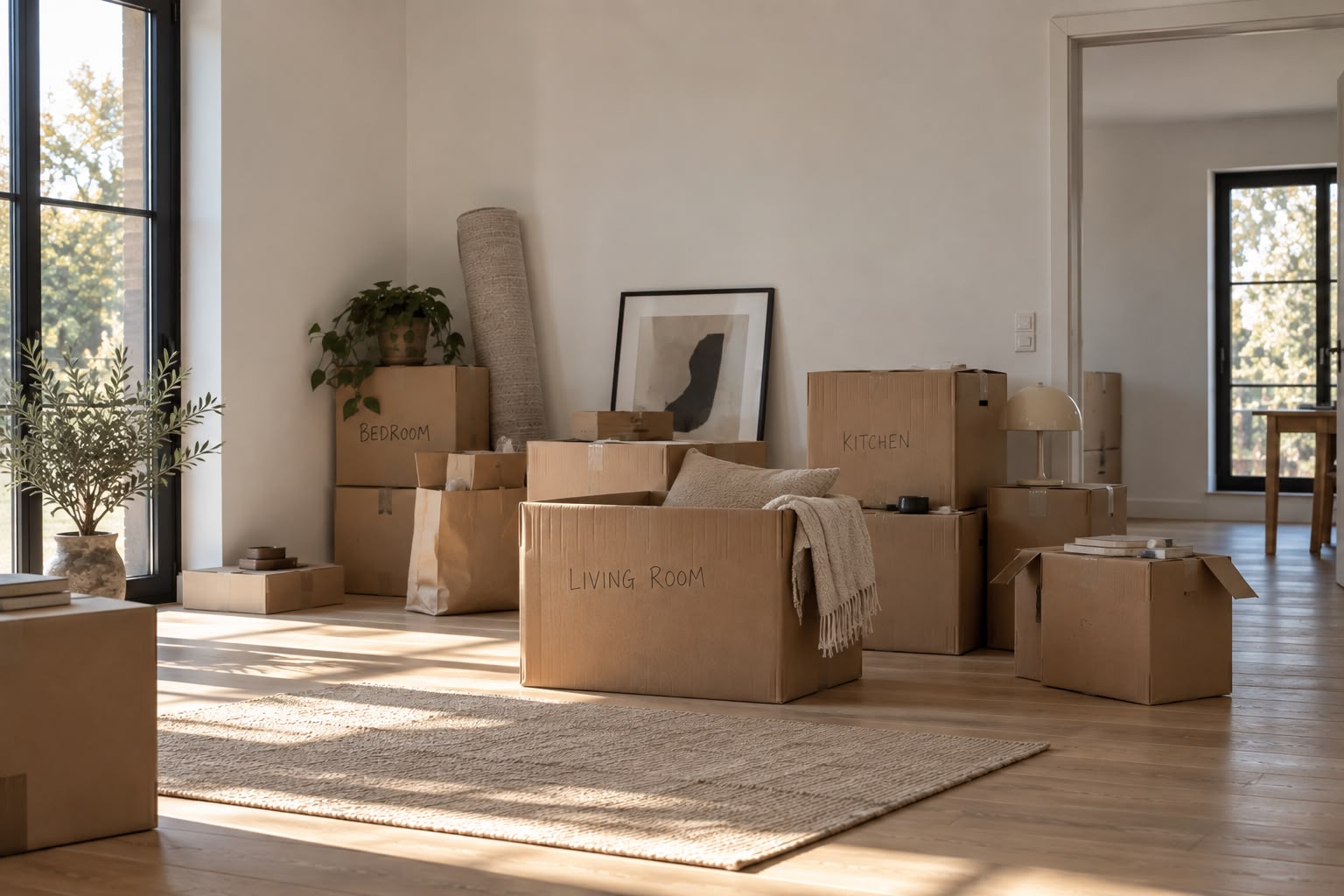
I have moved countries several times myself, and each move has taught me something slightly different about what makes a place begin to feel like home.
Sometimes we moved with furniture and belongings that had already travelled with us before. At other times, we had to create a home almost from scratch. What I have learned is that neither taking everything nor starting completely anew is necessarily the answer.
A successful move is about deciding what deserves to continue the journey with you — and what can make space for the life ahead.
Before you move: choose what matters
If you are relocating with your furniture, particularly when your company is covering the move, you may have the freedom to take more with you. Even then, I would use the move as an opportunity to look carefully at what you own.
Which pieces do you genuinely love? Which do you use? Which have a story, practical value or sentimental meaning?
A dining table where your family has spent years together may be worth moving across continents. A beautiful chair you have always loved may immediately give an unfamiliar room a sense of continuity. But a large piece bought simply because it fitted your previous apartment may not deserve the same journey.
You can be generous in what you take without moving everything indiscriminately.
Take the pieces that still belong in your story.
Starting fresh? Don''t start completely from zero
If you are moving with very little and expect to furnish your new home locally, my advice is almost the opposite: don''t arrive with nothing.
Take a few things that are unmistakably yours.
A photograph. A small lamp. Two favourite mugs. A vase. Bed linen you love. A few books. A small piece of art. Something from your kitchen that you use every day.
It may mean paying for one extra suitcase. But in the first days and weeks, when almost everything around you is unfamiliar, these small objects can have disproportionate value.
A few carefully chosen familiar objects can create continuity without trying to reproduce the home you left behind.
Choosing your new home: think beyond first impressions
Finding a new apartment is exciting, particularly in an unfamiliar city. But this is also where it is easy to be distracted by first impressions.
A beautiful period apartment may have extraordinary character. A completely modern apartment may look immaculate. Neither automatically means that it is the right home for you.
Try to imagine an ordinary Tuesday rather than the first viewing.
Where will the coats go? The suitcases? The vacuum cleaner? Sports equipment? Children''s belongings? Where will you work? Where will you eat? Can you move comfortably around the furniture?
And perhaps most importantly: where will everything be stored?
Storage is one of the things I pay particular attention to when looking at a potential home. Whether you love a layered interior filled with objects or prefer a very minimal space, not everything needs to be visible. Good storage reduces visual noise and allows the things you genuinely want to see to have more presence.
Look at the light — not only the view
Daylight deserves its own consideration.
A home can feel completely different depending on its orientation, window size, surrounding buildings, climate and season.
An apartment that feels wonderfully bright during an autumn viewing may receive intense sun and become uncomfortably hot in summer. Another that feels pleasantly shaded in July may be surprisingly dark in winter.
Notice where the windows face. Think about when you will use each room. Consider not only whether there is enough daylight, but whether there might sometimes be too much.
Ideally, visit at a different time of day. If that isn''t possible, understanding the orientation of the apartment can already tell you a great deal.
Before buying furniture, understand the space
Once you have the keys, there can be an enormous temptation to make the home feel finished immediately. I would resist it.
If furniture has travelled with you, begin by understanding how those pieces work in the new architecture. If you are buying new furniture, take the time to understand the proportions of the rooms before ordering everything.
Scale matters. A delicate sofa and tiny rug can disappear in a generous living room. A deep, heavy sofa or oversized dining table can overwhelm a smaller apartment even when it technically fits.
Measure first. Think about circulation. Look at the relationship between pieces rather than choosing every item independently.
Then live in the space for a little while. Where do you naturally sit in the morning? Where does everyone gather? Where do bags accumulate? Where do you read? Which corner is darker than you expected?
Often the home itself tells you what it needs once you give it a little time.
Let the old and new meet
A new home does not need to become a replica of the one you left behind.
In fact, I think the most interesting relocated homes often happen when the things that travelled with you meet the place where you have arrived.
Your existing furniture may sit alongside something made locally. An artwork from one country may hang above a table found in another. A familiar lamp may illuminate a completely different architecture.
The result becomes layered over time. It reflects where you came from without ignoring where you are now.
Take your time — but finish the home
I often tell clients not to rush. But taking your time does not mean leaving the home unfinished indefinitely.
Once the larger pieces are in place, there is another layer that makes an enormous difference: curtains, rugs, lighting, cushions, artwork, books, plants and personal objects.
I am a great believer in curtains. They soften architecture, improve privacy and can completely change the proportions and atmosphere of a room.
I almost always recommend plants as well. They bring life, texture and an organic element into a new interior.
Then come the smaller things: the lamp beside the sofa, the books on a shelf, photographs, ceramics, a cushion with the right texture.
These details are not simply decoration. They are often the moment when a space stops looking like somewhere you have moved into and begins to feel like somewhere you live.
The fresh start I love about moving
There is one more thing I love about moving: the feeling of a fresh start.
Every time I move, I notice the same thing. Once the boxes are unpacked and everything begins to find its place, I feel somehow lighter. There is less clutter, everything feels more organised, and I am suddenly much more aware of what I own and why I have chosen to keep it.
Moving gives us a natural reason to go through our belongings and ask questions we rarely ask when we have lived in the same home for years: do I still use this? Do I still love it? Does it have a place in my life now?
When we stay in one place for a long time, things have a way of accumulating almost invisibly. Cupboards fill up, drawers become crowded and objects remain simply because they have always been there. A move interrupts that process. It makes us look at our possessions — and sometimes our habits — with fresh eyes.
And I love the feeling that comes afterwards. Everything feels lighter, clearer and somehow new again.
Of course, you don''t actually have to move house to experience it.
Every now and then, I think it is worth creating what I like to call a "fake move." Imagine that you were moving tomorrow. What would you genuinely choose to pack? What would be worth carrying with you? What would you happily leave behind?
Go through a cupboard. Reconsider a room. Move a piece of furniture. Clear a shelf. Give away the things you no longer need and rediscover the ones you had forgotten you loved.
It doesn''t need to become an exercise in minimalism. The aim is not to own as little as possible. It is to become more conscious of what we choose to live with.
Sometimes a fresh start doesn''t require a new address. Just a fresh look at the home — and the things — we already have.
A new chapter, not a blank page
Settling in is not about recreating the home you left behind. Nor does moving somewhere new mean erasing everything that came before.
It is about carrying enough of your story with you to feel like yourself, while leaving room for a new place, new discoveries and a new chapter of your life to become part of it.
A new home does not need to start with a blank page. Some of the best stories continue from where the last one left off.